
The Unselected Journals of Emma M. Lion
by Beth Brower
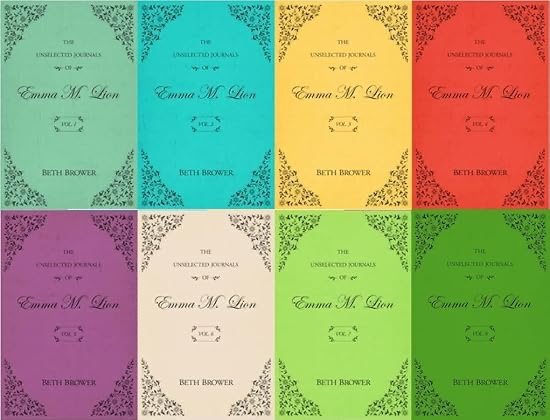
Genre: Historical Fiction
Number of Volumes: 8
Publication Date: 2019 - series in progress
My Rating: 5 / 5
Dates Read: 1/14/2026 - 2/4/2026
Trigger Warnings: Grief, child abuse, alcohol use, violence
Author
Beth Brower is an American author with a degree in literary studies. Best known for The Unselected Journals of Emma M. Lion, her work is praised for its humor and period charm. In addition to the Emma M. Lion series, she has published other novels including The Q, The Beast of Ten, and The Books of Imirillia trilogy
Premise
Written as journal entries, The Unselected Journals of Emma M. Lion follows a young woman in the late 17th century as she takes up residence in the delightfully odd London neighborhood of St. Crispian’s. What follows is a series of social missteps and small catastrophes rendered humorous by Emma’s quick wit and quicker pen.
Characters: 5/5
A lot of this series’ success can be attributed to the authenticity of Emma’s voice. The journal format is an excellent stylistic choice; it allows her intrinsic wit, humor, and sarcasm to shine as she attempts to navigate social tact, fend off unexpected visitors, and manage the daily chaos that never fails to find her.
Because the entries take place directly after the events themselves, you don’t feel the separation that can occur when a narrative is told as a recounting of past events. The format makes the reader feel close to Emma; you are inside her head, privy to her private frustrations and perfectly phrased internal commentary.
Emma is an exceptionally likable protagonist. She has a positive attitude, a general goodwill toward others, and can befriend just about anyone. Her charm—and uncanny tendency to end up in unlikely situations—enables her to collect a wonderful circle of companions, diverse in age, gender, and social status. This group includes (but is not limited to) a vicar, a Duke, a war photographer, and a middle-aged woman who has pledged herself to silence. The dynamic between these characters is the true heart of the story.
There are a number of side characters who add energy and banter to the story as well, including Emma’s cook, butler, banker, and problematic family members.
Across the series, Emma evolves in meaningful ways as she begins the journey of acknowledging her past and moving forward. Unresolved tensions for other characters have been foreshadowed, hinting at growth to come in later volumes.
“Irrational, perhaps, to feel such conviction that they are mine and I theirs.”
Setting: 5/5
St. Crispin’s is a quirky neighborhood that suits the story perfectly. The setting’s unique absurdities make it a character in its own right; a Roman ghost, mysteriously disappearing possessions, an overzealous neighborhood committee, and exclusive annual reenactments of Shakespeare’s Julius Ceasar being just a few of the things that keep Emma on her toes.
The story’s main setting is Emma’s London home, Lapis Lazuli House. The layout of the house activity shapes the story. Banished to the garret by Cousin Archibald, she observes, reflects, and records from her attic perch. When a tenant—the aforementioned war photographer—moves into Lapis Lazuli Minor, she finds that the thin walls make them a little closer than she anticipated. This unexpected intimacy propels their friendship forward during a time when a lady’s casual and unchaperoned acquaintance with an unmarried man was most improper.
There are a number of biblical references made throughout the books. Emma attends church—as would be expected of a lady during this time—and holds many conversations with her vicar, who is a main character in the series. In addition to these conversations, scripture surfaces naturally in her journal entries—sometimes quoted directly and sometimes alluded to—the way well-loved quotes come to mind during relevant situations. These references are non-intrusive; they don’t attempt to sway the reader morally or spiritually. Rather, they provide some insight into what shapes Emma’s worldview and contribute to the atmosphere of the story.
The series also makes frequent references to popular books from the time period. Emma loves to read, often quoting Jane Eyre, Shakespeare works, and other pieces of classic literature. It’s clear throughout the series that these stories have a lot of impact on who Emma is as a character.
Plot: 5/5
Early volumes lean into humor and atmosphere as characters are introduced and relationships are formed. The stakes are intentionally low to start (particularly in the first couple volumes), with Emma’s commentary as the story’s initial appeal. As the series carries on, the stakes deepen; personal histories are revealed, vulnerabilities are acknowledged, and the social implications of this unlikely friend group begin to come into play.
The story is largely character driven, with the plot determined more by Emma’s choices than any outside force. Conflicts arise from social misunderstandings, personal vulnerabilities, and the after effects of her interactions. The characters’ decisions (rather than dramatic events) carry the momentum, which allows their emotional journeys to act at the focal point of the story.
The journalistic structure creates a lot of momentum. Emma’s commentary makes it extremely easy to get into and the short earlier volumes make the series feel accessible.
Small mysteries—like the quirks of St. Crispin’s and the personal histories of Emma’s friends—add an addictive quality to the story. Though some unknowns are quite drawn out and may begin to feel frustrating, they do create a strong sense of anticipation and intrigue.
Importantly, though the narrative grows more serious with each installment, the overall tone of the story never loses Emma’s natural wit and warmth that made the earlier books so readable.
Themes: 5/5
A central theme—particularly early on in the series—is grief. Emma has endured the loss of both of her parents, as well as the man she loved. This comes up often, and is finally faced head-on in volume 4. A similar past loss is hinted at for another main character later on, with indication that it will be explored more in future installments.
Closely tied to this is the exploration of war’s futility. Her neighbor’s profession as a war photographer forces recognition of this. He encourages Emma to look at his photographs, causing her to confront not only the realities of conflict, but also the loss of her lover who died in Afghanistan. Knowing that he joined the army as a young, eager boy intensifies this tragedy.
Emma’s independence and autonomy are undercurrents throughout the series. Forced into a difficult financial position from the start, she’s determined to keep Lapis Lazuli despite financial strain. From her friendships to the way she dresses, she consistently operates just outside of expected boundaries of her social sphere. Her determination to shape her own life is a trait that defines her character.
One of the most important foundations of the story is friendship. Emma is held up by her friend circle and, in turn, she holds them up as well. In moments of grief, uncertainty, and vulnerability, it is this unlikely constellation of companions that provides strength to keep going.
Together, these themes prove that beneath the story’s inherent wit and whimsy lies something profound.
“I’ve decided positivity is the Everest of virtues. You have to not only confront the dismal realities of life but choose, ofttimes, to blatantly ignore them.”
Emotional Impact: 5/5
The low stakes at the start of the series allow for readers to gain connection to the characters before the narrative introduces more emotional intensity. By taking the time to ground the reader in Emma’s world, the series ensures that the emotional impact is strongly felt when conflicts grow more serious and vulnerabilities are revealed.
Because events are experienced through Emma’s journal, both highs and lows are keenly felt. The weight of her personal history never feels forced; grief surfaces naturally as painful moments sneak into day-to-day life.
The emotional depth is never at odds with the series’ inherent warmth; instead, the humor highlights the humanity behind each triumph and setback, making the emotional payoff both satisfying and poignant.
Personal Enjoyment: 5/5
If you’ve read up to this point, I’m certain it’s obvious I’ve loved this series. What makes it so enjoyable isn’t any one thing, but how it all comes together.
Emma is a character unlike any other; her humor and light-hearted nature radiate from the page. I loved hearing her personal thoughts almost as much as I enjoyed watching her interact with the world.
The side characters were memorable, not just because of their eccentricities, but because they feel fully realized, each shaping Emma’s experiences in ways that are funny, touching, and sometimes surprising. The banter was exceptional and the peculiarities of St. Cristian's a delight. As someone who primarily reads for memorable characters, this focal point of the story really worked for me.
While reading these books I felt completely immersed in the story. The combination of the cleverness, humor, and poignant emotional depth made the series a joy from start to finish. Can’t wait for the next installment, which Beth Brower has shared will, indeed, be released this year. Rhysdon Press, please know that I’m willing to sell my soul for an ARC!!
See my ratings for each individual book below:

