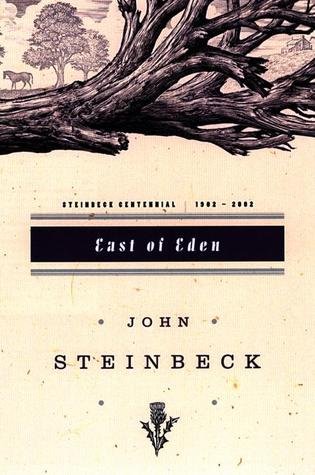
East of Eden
John Steinbeck
Genre: Literary Fiction / Historical Fiction
Pages: 608
Publication Date: 1952
My Rating:
Dates Read: 01/04/2026 - 01/27/2026
Trigger Warnings: parental neglect, suicide, prostitution, alcoholism, violence
Author
John Steinbeck (1902–1968) was an American writer whose work was known for exploring social injustice, morality, and the human condition. He was awarded the Nobel Prize in Literature in 1962 for his “realistic and imaginative writing,” including novels such as East of Eden, The Grapes of Wrath, and Of Mice and Men.
Premise
Inspired by the biblical story of Cain and Abel, this multi-generational novel follows the Hamilton and Trask families in California’s Salinas Valley. As rivalries and resentments repeat across generations, the novel questions whether individuals are irrevocably bound by their nature and lineage.
Characters: 4/5
East of Eden features a large cast of characters, with the story spanning multiple generations. Among this cast, there’s an array of personality types, including dreamers, idealists, cynics, and manipulators. This variety is important to the book thematically, as it allows Steinbeck to explore how traits, beliefs, and family history impact choices over time.
While many of the characters are memorable, they feel more symbolic than human. Several characters seem created only to serve the story’s premise, rather than as emotionally complex individuals with the potential to exist outside of the story. Cathy Ames (the mother of Caleb and Aron Trask) in particular felt positioned merely as a moral extreme. From the beginning of the story she’s portrayed as innately cruel, manipulative, and void of empathy. Unlike other characters, whose flaws are shaped by circumstance or choice, Cathy is presented as fundamentally evil, with almost no reasoning for her behavior. For a story so focused on the idea that humans can choose goodness, Cathy’s character felt out of place.
Steinbeck uses similar (though less extreme) instances of contrast elsewhere in the novel, first juxtaposing Adam and his brother, Charles, followed by Caleb and Aron later in the story. In both pairings, one sibling is positioned as inherently “good” through gentleness and idealism, while the other is more restless, emotionally complex, and burdened by self-awareness.
There is also diversity in the growth the characters undergo (or don’t). Adam Trask’s idealism remains largely unchanged throughout the story, even as it repeatedly leads to disappointment and isolation. Adam fails to let these events change him, and his journey is more about preserverence than growth.
Caleb, on the other hand, comes closest to a conventional character arc. His awareness of his own moral complexity sets him apart from the other characters, and his struggle is internal rather than circumstantial. Unlike Aron, who clings to idealism, Cal is burdened by self-understanding and the fear that he is inherently “bad”. His journey is defined by the realization that choice, rather than any sort of intrinsic nature, is the measure of goodness.
“And this I believe: that the free, exploring mind of the individual human is the most valuable thing in the world. And this I would fight for: the freedom of the mind to take any direction it wishes, undirected. And this I must fight against: any idea, religion, or government which limits or destroys the individual. ”
Setting: 5/5
In the detail and care used in his descriptions, it’s unsurprising to leave that Steinbeck grew up in the Salinas Valley. The descriptions feel real and intimate, allowing the setting to come to life within the story.
Like the biblical Garden of Eden, Salinas Valley, California holds the promise of abundance—a guarantee that is most assuredly felt by Adam Trask in the beginning of the novel. Later on, his unhappiness despite his wealth and fertile land suggests that abundance does not inherently lead to fulfillment; rather, it enables passivity through the privilege of idleness.
In contrast, the Hamiltons occupy dry, infertile land and live in poverty, yet are portrayed as a welcoming and lively bunch. Their household thrives on connection, humor, and resilience rather than material success. This contrast reinforces the story’s focus on circumstance and choice. While the Trasks inherit abundance without purpose, the Hamiltons create meaning in the little that they have.
Plot: 4/5
Narrated by a grandson of Will Hamilton, the story is told episodically. Rather than building toward a single climax, the narrator drifts through important moments in time, with mention of his own thoughts and perspectives.
The timeline is expansive (spanning around 60 years), which allows Steinbeck to explore how patterns of behavior resurface within families. This, however, makes for quite a long novel. The pacing is consistent throughout, but is slow-moving and can feel meandering at times. The first half was the most engaging as characters and conflicts were introduced. But, as the story continued, philosophical discussions slowed momentum. In addition, the pacing was impacted by pauses to explain the symbolism/ biblical references. Characters frequently reflect in ways that feel designed to underscore the story’s themes, rather than like normal conversations or thought patterns.
Themes: 4/5
The most prominent theme that Steinbeck explores is the choice between good and evil, questioning in particular if humans are destined to repeat the sins of their family. Through generational parallel, the story asks the audience to consider whether being born into a pattern dooms one to repeat the same mistakes. When Caleb discovers his mother’s casual cruelty, he fears that he’s destined to be inherently “bad”. By positioning Aron as Cal’s opposite, Adam reproduces the same pattern of favoritism that negatively impacted his own childhood.
The story references the Hebrew word “timshel”, which appears in the biblical story of Cain and Abel. Traditionally, it was translated into English as “thou shalt,” implying a command or moral obligation to triumph over sin. However, Steinbeck spotlights an alternative Hebrew translation, “thou mayest”. This translation shifts the meaning from duty to choice, reinforcing the novel’s argument that individuals are not doomed by their family history or inherent nature, but are instead given the freedom to choose their actions.
Though sometimes lacking subtlety, East of Eden is thematically rich, addressing questions about morality, inheritance, and choice. Cathy's character, however, strongly contradicts the story’s central idea. While certainly done as a way to perpetuate Cal’s journey, this weakens the scale of Steinbeck’s message, as Cathy’s apparent lack of choice suggests an exception to the very principle the novel works so hard to defend.
“This is not theology. I have no bent towards gods. But I have a new love for that glittering instrument, the human soul. It is a lovely and unique thing in the universe. It is always attacked and never destroyed - because ‘thou mayest’.”
Emotional Impact: 3/5
Overall, East of Eden left me feeling more reflective than moved. The reflective quality of the narration style kept the characters at arms length, never pulling me into intense moments of grief, joy, etc. Because the oven is more strongly rooted in observation and reflection, it didn’t carry the same emotional weight that more character-focused stories do.
Many scenes feel designed to illustrate the story’s thematic concepts, rather than to immerse the reader in one specific moment. As a result, moments of struggle or conflict were rarely felt on an emotional level. Even with Caleb, whose internal struggle felt the most human, there remained a barrier between his struggle and my own emotional investment.
Still, the story ended with an emotional note that carried beyond the page and invited reflection.
Personal Enjoyment: 4/5
The element of the novel that held my attention the most throughout the story was Steinbeck’s descriptions of the Salinas Valley. His attention to detail, combined with narration style, made the setting feel lived in and deeply connected to the story itself.
While I understand why East of Eden resonates deeply with many readers, I found myself somewhat unmoved by its central moral question. The idea that goodness is a matter of choice is not something I’d ever struggle to accept, so the novel’s central argument never felt especially revelatory to me. This didn’t make the book unenjoyable, but it did make me question the disconnect that prevented me from seeing this as the awe inspiring novel that many find it to be. However, I felt that the ending was perfect; it tied back to the heart of the story and was open-ended in a way that felt hopeful rather than incomplete.
Overall, I enjoyed reading and deeply appreciated experiencing a story that has remained prominent for so many years. I’m very excited to see how the thematic focus of the story translated to the screen in the adaptation coming to Netflix later this year (read about it here).
For those who intend to read East of Eden, it may be important to note that the novel often assumes familiarity with the biblical stories it draws from, particularly Adam and Eve and Cain and Abel. Readers who are unfamiliar would likely benefit from some basic research before reading, as some references may feel random otherwise. These references, often incorporated through thought and conversation, often pulled me out of the story.
I may earn commission from qualifying purchases that use the links included.
