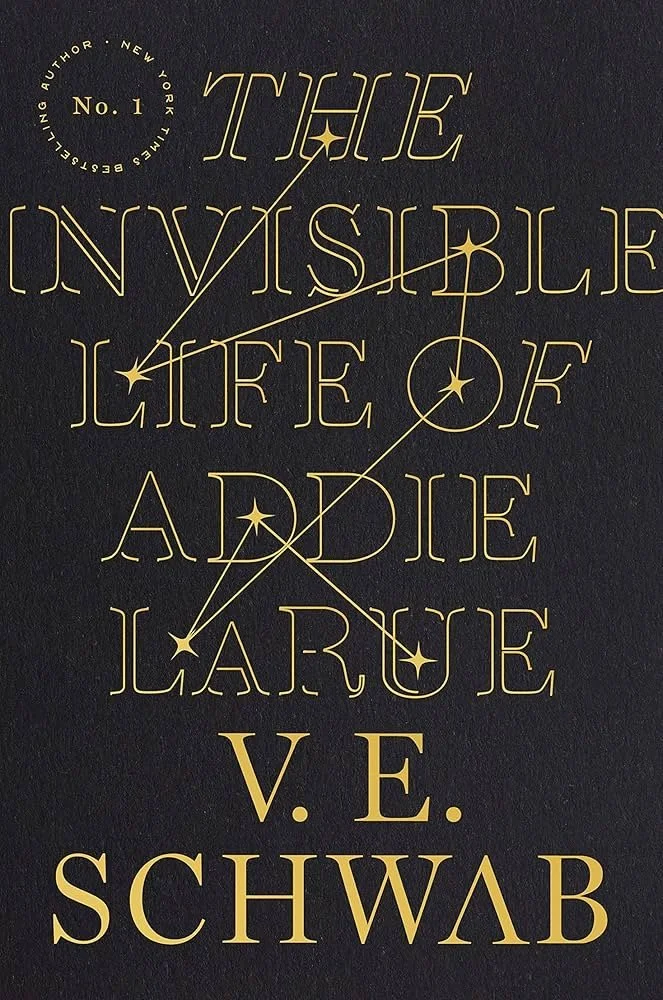
The Invisible Life of Addie LaRue
By V.E. Schwab
Genre: Fantasy
Pages: 448 (paperback)
Publication Date: 2020
My Rating: 4.5
Dates Read: 10/03/2025 - 10/09/2025
Trigger Warnings: Suicidal thoughts, emotional abuse, starvation, prostitution, substance abuse
Author
V.E. Schwab, with over twenty New York Times bestsellers, is one of the most prominent names in fantasy. She is best known for the Shades universe, the Villains series, and The Invisible Life of Addie LaRue.
Premise
In 18th century France, Addie LaRue feels trapped by a life she never asked for. When she makes a bargain to live forever, she never expects the catch: no one she meets will remember her. Addie learns to make the most of her life as the years pass by, but everything changes almost
three centuries later when she meets a man who recalls her name.
Characters: 4/5
At the beginning of the story, Addie is driven by her desire to steer her own life. Isolated in her small village and pressured to marry by her controlling mother, there’s nothing that she wants more than freedom.
As a character who lives not only through lifetimes but centuries—who survives war and famine, watches cities torn down and rebuilt—she changes less than one might expect. Addie changes in practical ways, like learning how to adapt to the struggles of her curse, but she remains intrinsically the same. Even when her circumstances leave her with little to work with, she remains stubborn, idealistic, relentlessly resilient, and deeply unwilling to surrender her sense of self. In her most powerless moments, she still refuses to let go of the sense that her life is her own to control.
Addie’s steadfastness speaks to who she is as a character, but it also means her personal arc lacks transformation. At times, it felt like she was accumulating experience without actually evolving. Some may view this as a flaw with her character, while others may see it as a testament to her enduring spirit.
Addie’s relationship with Luc, the being who grants her bargain, is complicated and compelling. He’s not simply a villain; he’s charming, attentive, and–most impactfully–the only constant in Addie’s life. Luc’s interest in Addie is obsession and possession sometimes masked as fondness. Addie clings to him despite all he’s done because she’s unable to let go of the last connection to a normal life. Their dynamic is one of loneliness and longing that is shared between two beings who both operate outside the normal world.
Where Luc represents power and eternity, Henry is deeply human. He’s soft-hearted, yearning for meaning, and often overwhelmed by the pressure of being “enough”. Where Addie endures through centuries, Henry is living with time’s pressure of a mortal existence. Their relationship brings a gentle intimacy to the story that contrasts sharply to her toxic and manipulative dynamic with Luc.
“If she must grow roots, she would rather be left to flourish wild instead of pruned, would rather stand alone, allowed to grow beneath the open sky. Better that than firewood, cut down just to burn in someone else’s hearth.”
Setting: 5/5
The story begins in the small, French village of Villon-sur-Sarthe in the early 18th century. We follow Addie as she moves across Europe while the world continues to evolve around her. Addie experiences the French Revolution and both World Wars, but the narrative treats these more as memories, so they feel like glimpses rather than events happening in real time.
In the contemporary timeline, the populated and fast-moving city of New York serves as a representation of Addie’s loneliness. At this point, she’s lived in NYC for several years and, with plenty of time to pass, knows many of its secret corners and hidden gems. The city is crowded but isolating; she’s surrounded by millions of people who will never remember her and, thus, she becomes both everywhere and nowhere at once.
Plot: 4/5
Dual timelines weave together, shifting between the start of Addie’s bargain and her present-day life in New York. The structure gradually reveals how she has adapted to her situation and builds up to the emotional heart of the story. The alternating timelines give the story a reflective quality, but does take away from the momentum.
The pacing is somewhat uneven. The middle section slows down, with some scenes that feel like they serve to emphasize ideas we already know. The plot comes together nicely at the end, however, with strong emotional payoff.
Themes: 5/5
One of the story’s most prominent themes is the human desire for connection. Though Addie cannot be remembered, she never stops seeking to form bonds with others. She returns to the same people again and again, knowing she’ll have to start over each time. She doesn’t shy away from passion or intimacy no matter how fleeting. Her repeated attempts to form relationships highlights the natural need for human connection.
Henry’s storyline explores this from a different light. He has the unwavering love, support and approval of his friends and family but, because their devotion is blind, it lacks meaning. This contrasts to Addie’s need to be vulnerable and authentic to achieve even short-lived moments of connection. Henry’s arc shows us that genuine connection is not about constant approval and admiration, but about being seen and acknowledged for who we truly are, regardless of flaws.
The story also explores the human desire to create lasting impact as Addie seeks to touch the world in any way she can. By spreading ideas they’ll never recall the root of, she is able to inspire the lasting work of artists and musicians.
“Because time is cruel to all, and crueler still to artists. Because visions weaken, and voices wither, and talent fades.... Because happiness is brief, and history is lasting, and in the end... everyone wants to be remembered.”
Emotional Impact: 4/5
The sense of loneliness Addie’s story creates is profound, and her fleeting moments of connection feel so bittersweet. Her ability to find meaning and purpose despite her situation was inspiring and added a hopeful undertone to the story.
Henry’s journey provided another layer of emotional depth. His race against the clock of mortality felt deeply human, especially contrasted to Addie and Luc’s immortal lives.
Personal Enjoyment: 4/5
Schwab’s prose is absolutely beautiful and, because of that, I felt entirely unbothered by the pacing and repetitive scenes. I was deeply immersed in the melancholic and haunting feel of the story, which was a mood I enjoyed all the more as an October read. The atmosphere stuck with me most, and I am definitely interested to know if her other books have a similar vibe.
Though I was invested in her journey and hopeful that she would find happiness, I didn’t feel incredibly connected to Addie as a character. I enjoyed the complexity of her relationship with Luc, as well as the comfortable simplicity of her relationship with Henry.
I 1000% felt that the ending was coming, but in an inevitable way rather than a predictable one. It perfectly represents that mortality isn’t the only thing that makes us human. Rather, it’s willingness to sacrifice, capacity for empathy, and the vulnerability of having something to lose.
I may earn commission from qualifying purchases that use the links included.
