
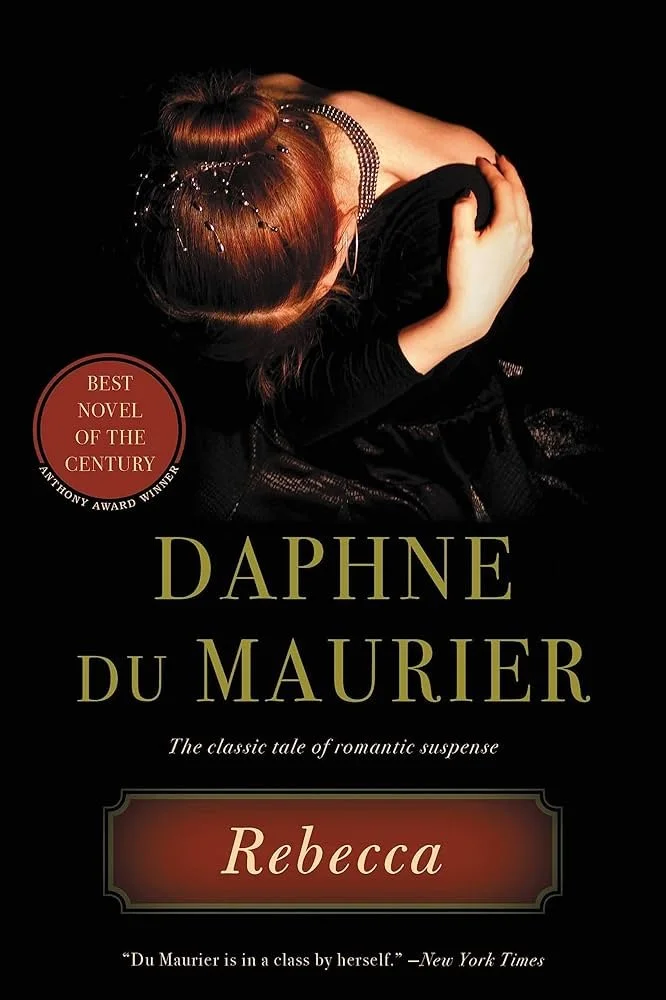
Rebecca
By Daphne du Maurier
Genre: Gothic fiction
Pages: 448 (paperback)
Publication Date: 1938
My Rating: 4.25
Dates Read: 9/24/2025 - 10/11/2025
Trigger Warnings: Emotional abuse and manipulation, discussion of murder (not graphic), suicidal thoughts, ableism
Author
Daphne du Maurier (1907-1989) was one of the most prominent English authors of the 20th century. A number of her books have been adapted into films, including Jamaica Inn (1939 and 1981), Rebecca (1940 and 2020), Frenchman’s Creek (1944), My Cousin Rachel (1952 and 2017), The Scapegoat (1959 and 2012), The Birds (1963), and Don’t Look Now (1973). Several of her works, including Rebecca, have become known as modern literary classics and continue to receive praise for their psychological depth and atmosphere.
Premise
When the unnamed narrator goes from shy lady’s maid to wife of the wealthy widower Maxim de Winter, she soars beyond her societal rank into a world that feels both glamorous and deeply intimidating. When she arrives at Manderly–the expansive Cornish estate she’s now meant to call home–her insecurities become her greatest torment as she struggles to find her place beneath the shadow of Maxim’s late wife, Rebecca.
Characters: 3.5/5
As readers, we get a very intimate look at the narrator’s insecurity, which is the primary factor controlling her actions and choices. Her lack of self worth went beyond that of a typical self-conscious young woman, likely paying homage to struggles with mental health. As I watched this impact her life, I was dying for her to stand up for herself, speak her mind, or share the questions she was too afraid to ask.
I found her character to lack of relatability; her insecurities felt so all-consuming at times that it was difficult to resonate with her. I also struggled to feel invested in her journey because of her inaction; her character was so passive that it prevented her from taking proactive steps to solve her problems.
We learn very little about her personal history. We know from the synopsis that she’s an orphan, but never learn about any other experiences or feelings from her childhood that may have shaped who she is as an adult.
Because of the MC’s hesitancy to connect with others, the side characters–especially Maxim and Mrs. Danvers–feel difficult to understand. The story doesn’t dive deeply into who they are and their relationships with the main character are limited to her skewed interpretation. This does feel intentional, because of her hesitancy to ask questions or actually understand the people around her. Her lack of action reflects her feelings of insecurity, as well as her isolation within Manderly and the societal expectations that come with living there.
She and Maxim gave me, for lack of a better term, the ick. There’s an unsettling imbalance in their relationship, caused more by their gap in maturity than their gap in age. His dominance paired with her naivety makes their dynamic feel uncomfortable and even manipulative at times.
Reading from her perspective felt like being trapped in an anxious mind. Du Maurier makes us feel just how isolating her world has become, heightening the physiological tension that solidifies this story’s place in the gothic genre.
“I wondered how many people there were in the world who suffered, and continued to suffer, because they could not break out from their own web of shyness and reserve, and in their blindness and folly built up a great distorted wall in front of them that hid the truth.”
Setting: 5/5
This story takes place in the 1930s and is set primarily at Manderly, an estate in Cornwall, England. Manderly itself is a huge amplifier of the narrator’s insecurity. I’m unable to decide if the estate feels so daunting because of her state of mind, or if the intimidating beauty of the place is what creates her feelings.
The descriptions of seemingly normal landscapes are made to feel eerie, from the twisting drive to the house, to the cliffs lined with sharp rocks. The lingering presence of Rebecca continues to unsettle the MC, making her feel like an intruder in her own home. As she attempts to settle in at Manderly, she can’t escape Rebecca’s shadow–she sits at Rebecca’s desk, writing with Rebecca’s pen, surrounded by beautiful decor hand-selected by Rebecca. The estate is more than just a setting; it’s both a physical and psychological manifestation of her feelings of unworthiness and alienation. The story definitely wouldn’t be the same without this setting.
Plot: 4/5
The plot of Rebecca unravels slowly. It begins near the start of the narrator’s relationship with Maxim, and the sense of unease builds as her insecurities deepen. The story has an overarching sense of suspense that comes from atmosphere rather than action. As the mystery surrounding Rebecca’s death comes to the forefront of the story, the MC starts to blur the line between her own sense of self and her assumptions about who Rebecca may have been. The suffocating atmosphere builds with each new question that arises and Ms. Danvers’ strange behavior pulls her further into Manderly’s psychological web.
The narrator’s reaction to the twist stood out to me more than the twist itself. I don't want to share too much, so I’ll just say that it felt very valid given how deeply the MC’s identity depends on being loved. At first, her response seemed to lack resistance and felt too easy. After thinking more about the story, I realized that it was very much an intentional choice–one that shows exactly just how much her insecurities control her.
Themes: 5/5
Identity and insecurity are very prominent themes in this story. The narrator’s lack of a name represents her weak sense of self. She defines herself entirely through other people’s perception of her. Her sketching hobby comes up frequently throughout the book and, though she mentions she doesn’t have any particular talent, it seems that she enjoys the activity in the beginning. Despite limitless time and resources after moving to Manderly, she loses all interest in the pastime. The quiet abandonment of her interests and self expression reflect how she begins to value herself through the eyes of others. She no longer sees the point in creating something if she’s not good enough to be admired for it.
We’re reminded of her insecurities over and over as she’s practically crippled by comparison (did the saying “comparison is the thief of joy” not exist in the 30s?!). Branching off of this, a theme that really interested me was how a lack of knowledge can distort reality. Because the narrator is told so little about Rebecca, her imagination turns her into an almost mythical creature; someone extraordinary, untouchable, and perfect. The power Rebecca’s memory holds over her is a disturbing reminder of how easily we can lose ourselves when we define our worth through the imagined perfection of others.
Additionally, the story examines control through the narrator’s imbalanced relationships with Maxim and Ms. Danvers, alienation through her social awkwardness and fear of judgement, and social class through the way her lower status impacts her sense of belonging.
“I am glad it cannot happen twice, the fever of first love. For it is a fever, and a burden, too, whatever the poets may say.”
Emotional Impact: 4/5
The MC’s obsessive thoughts pulled me into her anxiety and Ms. Danver’s actions enhanced the sense of unease that I felt while reading. Rebecca isn’t the type of story to make you cry; its power lies in its tension, atmosphere, and psychological depth.
Personal Enjoyment: 4/5
I really enjoyed the descriptive prose and the gothic atmosphere (especially for my first read of October!). I also loved the way suspense is created in the absence of action and analyzing the MC’s insecurities. Though the setting was very immersive, the lack of character connection did draw me away from the story at times.
Rebecca remains an easy read almost 90 years later, with clear prose, a straightforward storyline, and just enough tension to keep the reader engaged. I hear it referred to often as an accessible classic and it definitely lives up to that.
This isn’t the type of story I typically reach for, but it was a great mix-up and I can definitely understand why its popularity has lived on for so long.
I may earn commission from qualifying purchases that use the links included.
